
Your Changing Body: All About the Abs
- Sep 22, 2013
- 5 min read

This week we are going to focus on the abdominal muscles. Your abdominal muscles are essential in helping you to achieve and maintain good posture, as well as core stability. Strong abdominal muscles will not only help you to push your baby out more easily, but the hard work that you put in during pregnancy to condition these muscles will help you immensely in recovering your abdominal strength after the baby arrives. Your abdominal muscles are composed of four layers: the rectus abdominis, internal obliques, external obliques, and the transversus abdominis. Let's take a look at each of these layers...
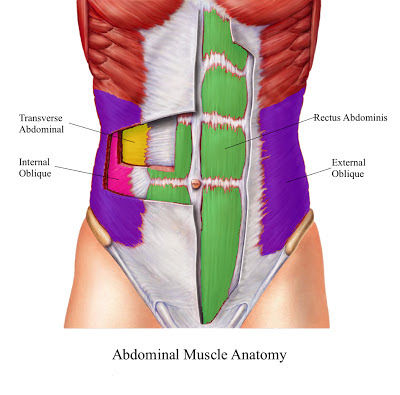
The rectus abdominis is the prominent muscle that lies like a sheath over the front of your abdomen. It stretches from the pubis to the rib cage and is divided vertically by a strong tendinous sheath called the linea alba. It is further segmented by three horizontal tendinous intersections. This is the muscle group that you you think of when you think of a "6-pack." This muscle serves to flex and rotate the lower region (lumbar) of the spinal column, as well as stabilize the pelvis during walking. Separation of the left and right sides of this muscle is called diastasis recti and is common during pregnancy.
The external obliques are the largest and most superficial of the three lateral muscles (obliques and transverse muscles) and are located on each side of the rectus abdominis. They run downward and inward from the lower ribs to the pelvis forming a V-shape. When the pair contracts simultaneously, these muscles assist the rectus abdominis in flexing the spine and compressing the abdominal wall. Individually, these muscles allow for sideways bending and rotation of the torso.
The internal obliques lie just below the external obliques. The internal and external obliques run at 90 degree angles to one another. These muscles serve the same functions as the external obliques: rotating the torso, sideways bending, compressing the abdominal wall, and flexing the spine.
The transversus abdominis is the deepest muscle of the abdominal wall. It's fibers, which run horizontally wrap around the torso from the front to the back and from the ribs to the pelvis. While this muscle does not aid in the movement of the spine or pelvis, it does serve to stabilize the spine, compress the abdominal contents, and aids in respiration and breathing.
Conditioning Exercises
During pregnancy, these muscles are being stretched more than usual due to your growing uterus. It is important to know your limits for abdominal work during pregnancy so that you can prevent any unwanted back or abdominal strains. Traditional abdominal exercises such as crunches and double leg lifts should be avoided during pregnancy, as well as any other exercise that causes excessive strain or bulging of the abdominal wall. Let's look at three safe and effective abdominal exercises for the pregnant (and postnatal) woman...
Pelivc Tilts
Pelvic tilts are a wonderful way to strengthen your abdominal muscles, relieve back pain, and improve your posture. Here we will look at three different ways that you can perform pelvic tilts. The position changes, but the exercise stays the same with all three.
Exercise: Take a deep inhale and on the exhale, tighten your abdominal muscles and hold for 5-10 seconds. Release. To tighten your abdominal muscles, think of cinching up a corset or zipping up a zipper engaging your muscles by starting with a kegel exercise and working your way up through your lower abdominals to your upper abdominals. Your pelvis will naturally tilt upward as you contract your lower abdominal muscles. Another way to understand this movement is to think of hugging your baby with your abdominal muscles as you contract. Do 10-12 pelvic tilts per day.
Pelvic tilt standing:

Begin this exercise by using the wall as support. Lean against a wall with your feet about 12-15 inches away from the wall and hip-width apart. Take a slight bend in the knees and let your shoulders and buttocks touch the wall. As you contract your abdominal muscles, your back will press into the wall. Hold the contraction for 5-10 seconds and release.
Once you feel confident, step away from the wall and repeat this exercise without the wall support. It helps to put your hands on your hips to feel the tilt of your pelvis as you contract your abdominal muscles.
Pelvic tilt on your back:
Lie comfortably on your back with your knees bent and feet flat on the floor. The natural curve of your back will cause there to be a small space between your back and the floor. As you tighten your abdominal muscles, your pelvis will tilt forward and your back will press against the floor closing that gap. Hold the contraction for 5-10 seconds and release. Check to make sure that you are not engaging your buttocks or pushing off the floor with your feet.
Note: If you become light-headed or dizzy in this position, roll to your left side and take a few breaths before coming to sitting. Try one of the other two positions for this exercise instead.


Pelvic tilt on hands and knees
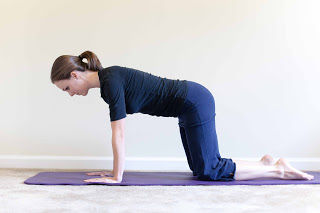
Find a hands and knees position on the floor making sure that your knees are directly below your hips and your hands directly below your shoulders. Starting with a neutral spine, allow your abdominal tightening to curl your pelvis under as your lower back arches. Hold the contraction for 5-10 seconds and release.

Transverse Abdominal Contractions
The transverse abdominis muscle is often forgotten in most training regiments, but it is so incredibly important! Not only does this muscle provide core stability, but it is essential in labor when you are actively working to push your baby out. Strengthening this muscle during pregnancy will benefit you greatly during labor, as well as set you up for success after the baby is born and you are working to regain abdominal tone and close any possible abdominal muscle separation. If you have ever taken a yoga or pilates class, you are probably familiar with this exercise.
During pregnancy, the best and easiest way to
perform this exercise is in an upright position. Either sitting in a chair or sitting cross-legged on the floor with your back supported by a wall, put one hand on your belly and take a nice long inhale, expanding your abdomen. On the exhale, slowly begin to engage your abdominal muscles starting with a kegel and moving your way up through your lower abdominals to your upper abdominals. Think of pulling your belly button toward your spine. Hold this contraction for 20 seconds while continuing to take deep slow breaths. As you near the end of the contraction, take a long exhale and slowly release your abdominal muscles so that you return to a neutral spine. Repeat this exercise 10 times, take a quick break and do one more set of 10. As you become stronger with this exercise, begin to increase the number of repetitions.
Once you feel confident in feeling your transverse abdominis contract, try adding in a different variation to this exercise by pulsing the contraction 10-20 times per 20 second contraction. To do this, release the contraction slightly on each inhale and engage it deeper as you exhale.
Opposite Limb Extensions
This exercise is often used in yoga and pilates and helps to strengthen your core and postural muscles. It also serves to improve stability and balance, as well as coordinate physical exertion with breathing (something that will be very helpful during labor)!

To do this exercise, begin by getting into a hands and knees position on the floor with your knees directly under your hips and your hands directly under your shoulders. Extending your right leg behind you with your toes pressed into the floor, engage your abdominal muscles to pull your belly button toward your spine. On an inhale, lengthen your right leg so that your toes are reaching towards the back wall (make sure that you are not leaning towards that leg, but maintaining a nice flat back). Exhaling, release your left arm in front of you and reach your fingertips to the front wall. Check that you are maintaining a neutral spine and that your gaze is on the floor. Take a few deep breaths here, holding that strong abdominal contraction as you reach your fingers and toes away from your body. Release your arm and leg and repeat this exercise on the other side. Do this exercise 5 times on each side per day.
During early pregnancy or after the baby is born, this pose can also be done lying on your belly.


Photos by LoveHopeFaith Photography


Comments